
 Facebook
 X
X
 Pinterest
 Copy Link
Radon in New Brunswick Homes: What It Is, Why It Matters, and When to Test
Radon is easy to ignore because you can’t see it, smell it, or taste it. Most people only think about it when it comes up during a home purchase or after they move in. The practical truth is simple: the only way to know your level is to test, and if it’s elevated, it’s usually fixable.
What radon is
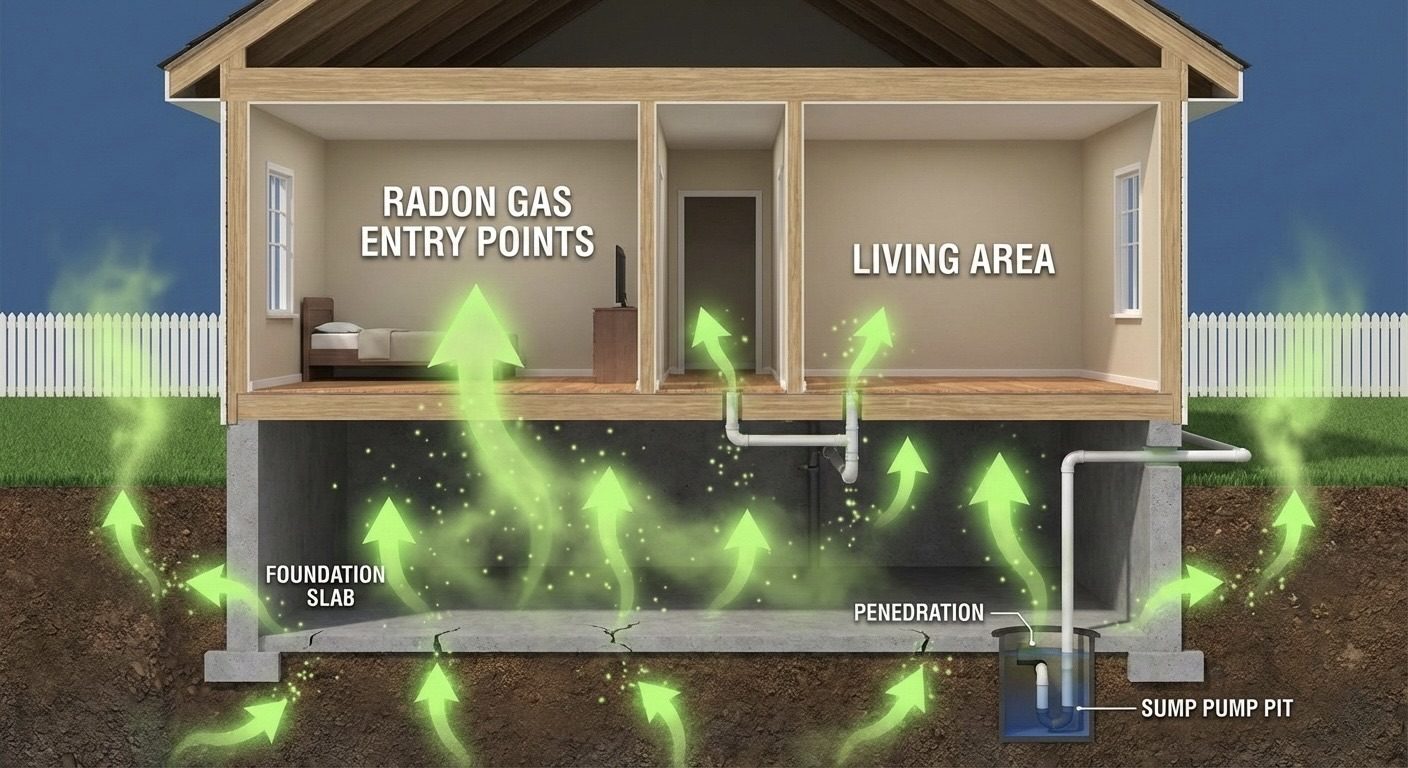
Radon is a naturally occurring radioactive gas that forms as uranium in soil and rock breaks down. It can move up through the ground and enter a home anywhere the building touches the soil. Common entry points include tiny foundation cracks, sump pits, floor drains, gaps around plumbing and wiring, and the seam where a slab meets the wall. During the heating season, pressure differences can draw soil gases into lower levels, which is why basements and ground floor areas are often the focus.
Why New Brunswick is often higher risk
Radon potential varies widely by location, but many parts of New Brunswick have geology that can produce more radon. Add a long heating season and homes that exchange less air in winter, and radon can build up indoors, especially in basements and lower levels.
How common is it
Public testing summaries for New Brunswick often report that roughly 1 in 4 homes tested were above the Canadian guideline of 200 Bq per cubic metre. That’s a useful warning sign, not a prediction for any specific property. The numbers can be influenced by who chooses to test, where programs are active, and which housing types are represented. The most important takeaway is this: two nearby homes can test very differently. Small differences in foundation condition, air movement, and ventilation can change the result.
The health risk, stated plainly
Long term radon exposure increases the risk of lung cancer. Public health agencies commonly describe radon as the leading cause of lung cancer among non smokers, after smoking. If someone in the home smokes, radon increases risk substantially because the combination is more harmful than either factor on its own. This is a long term exposure issue, which is why the length and placement of the test matter.
How to test in a way that gives you a reliable answer
You can’t guess radon. You test.
Best test: long term, 3 to 12 months Radon levels change with season, weather, and how the home is used. A long term test gives the most reliable picture.
Best season: fall or winter. Testing during the heating season often captures higher accumulation conditions because windows and doors are closed more consistently.
Best location: the lowest level you actually use. Place the test device on the lowest level that’s used regularly and follow the kit instructions. Even if a basement is mostly storage, it can still matter because air can move upward through the home.
If your result is above the guideline
An elevated result is not unusual, and it is not a reason to panic. It is a reason to act.
Mitigation is often effective
Professional systems commonly reduce radon significantly. The most common approach is sub slab depressurization, which uses a pipe and fan to pull radon from beneath the foundation and vent it outdoors. Because every home is different, the standard is to confirm results with a follow up test after installation.
Costs vary, but you can plan
Homeowners often report mitigation costs in the range of about $3,000 to $5,000, depending on foundation type and installation complexity. Treat that as a budgeting range, not a quote.
Keep documentation
Save the original test result, the invoice, system details, and the post mitigation result. It protects you if you sell later and gives you confidence that the work achieved the goal.
Financial help may exist
Some homeowners may qualify for assistance through programs referenced by provincial or lung health organizations. Availability and eligibility can change, so confirm current program details directly.
What this means for buying and selling in a competitive market
Radon is a measurable condition. The smart move is to measure it and respond based on the number.
For sellers
Testing before listing reduces uncertainty. If the result is elevated, mitigating ahead of time can prevent surprises and protect the transaction from last minute pressure. What to ask your REALTOR® before choosing a selling strategy.
For buyers in a competitive sellers market
In a hot market, asking the seller to test and fix radon before closing can weaken your offer. A common, practical approach is to buy the home, then test soon after possession. There is one trade off to be honest about: the most reliable test is long term, which takes months. If you want an early signal without delaying your offer, consider a short term screening test soon after you move in, then follow with a long term test during the heating season for the best read.
A simple buyer plan
1. Plan to test soon after possession
2. If you want an early signal, run a short term screening test in the first few weeks
3. Run a long term test during the heating season
4. If results are elevated, mitigate and confirm with follow up testing
5. Keep the documentation with your home records
Bottom line
In New Brunswick, radon is common enough that it belongs on your home care checklist. In a competitive sellers market, the practical move is often to keep your offer strong, buy the home, then test and address radon after possession. Measure it, act on the result, and keep proof.
More Fredericton real estate guidance and market insights here.
