
 Facebook
 X
X
 Pinterest
 Copy Link

A step by step plan to compare selling, staying, and changing housing type without rushing
Downsizing in Fredericton is often framed as a move to a smaller home. In practice, it is a decision about risk, support, and how you want day to day life to feel over the next few years.
For many seniors in Fredericton, the first signal is not the market. It is a winter that feels longer. A driveway that feels heavier. Stairs that start to shape your choices. The home is still loved, but it is starting to demand more than it gives.
Here is the part that gets missed in most conversations: moving is only one solution.
Sometimes the best decision is to sell and right size. Sometimes the best decision is to stay and remove the burden with better support. Sometimes the best decision is a change in housing type that adds safety and predictability. The right answer is the one that lowers risk and increases relief, without creating new problems you did not see coming.
This article is designed to help you have the right discussion first, so you can understand options, tradeoffs, and timing before you touch a single box.
Start with the real question: what risk are we solving
Most downsizing decisions begin with one of three triggers. The details vary, but the underlying risks are consistent.
1) The home starts costing energy
Snow clearing, lawn care, repairs, and stairs are not just tasks. They are recurring problems that take planning and attention.
But here is the counterpoint: if the home still fits your life in every other way, you may not need to move to reduce this burden.
This visual guide summarizes the three downsizing paths Fredericton homeowners typically compare.
In some cases, the simplest solution is delegation:
- Lawn and snow contracts

- Handyman support on a schedule
- A cleaner twice a month
- Small safety upgrades that prevent falls
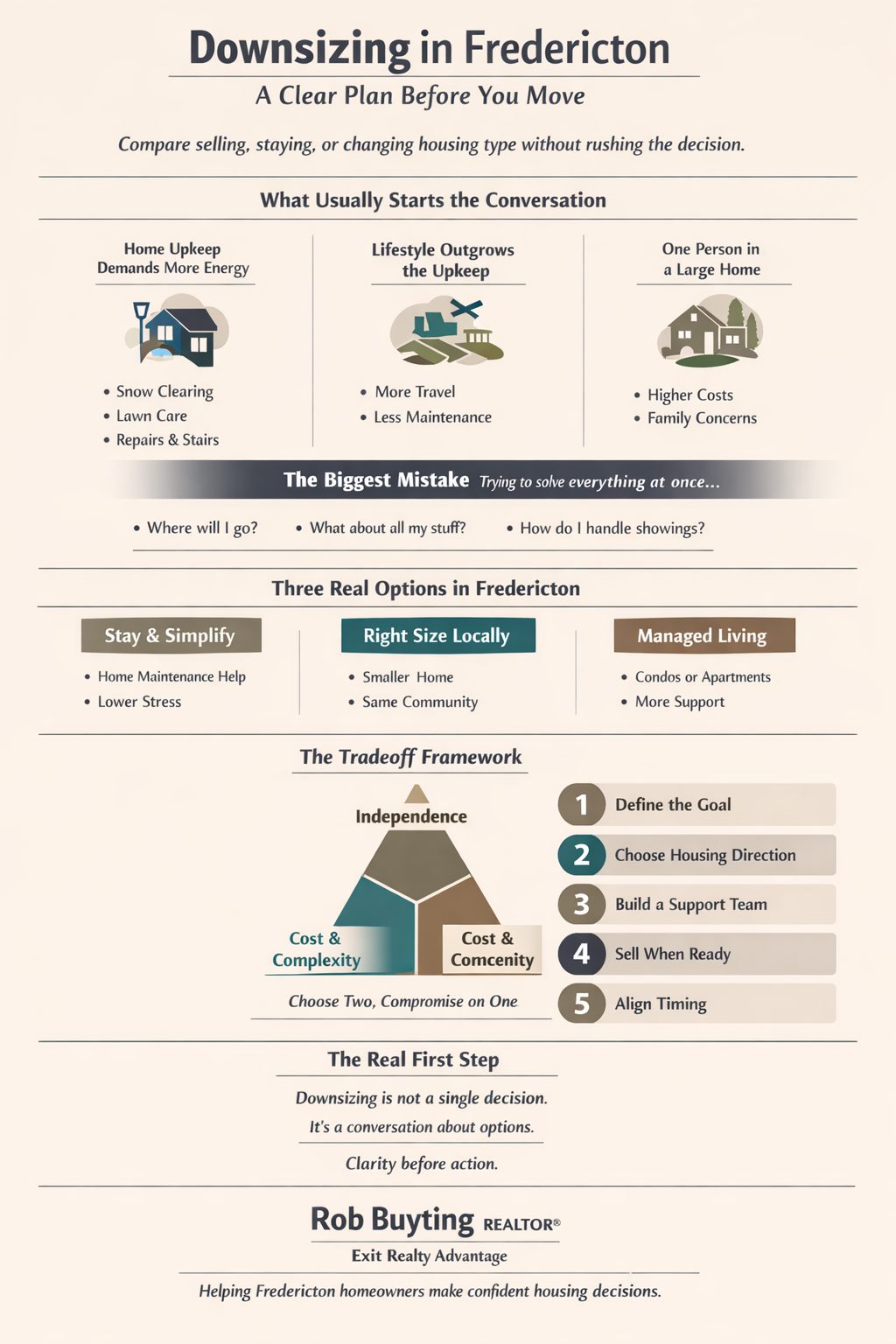
Downsizing is not always the cheapest path once you account for moving costs, transaction costs, and the effort of resetting a new home. The goal is not to move. The goal is to remove friction.
2) Lifestyle expands, tolerance for upkeep shrinks
Many seniors today have full calendars. Travel is back. Family time is valued. The desire shifts from owning space to owning flexibility.
Downsizing can deliver that, but it is not the only route. Some people get the same relief by simplifying routines, outsourcing maintenance, or renovating the home to reduce ongoing work.
The point is to separate the outcome from the method. If the outcome is more time, there are multiple ways to get there.
3) One person in a larger home, plus financial and family strain
When one person is living alone in a family home, costs, safety, and isolation can rise at the same time. Adult children may start pushing for a change, often from genuine concern.
The counterpoint is important: not all pressure is a signal that a move is required. Sometimes it is a signal that the family needs clarity on decision rights, timeline, and what support is available.
A plan can reduce tension, but only if the plan respects the person living in the home.
The biggest mistake is treating downsizing as a single decision
Almost no one gets stuck because they cannot sell a home.
They get stuck because they try to answer everything at once:
- What do I do with decades of belongings
- Where do I go next
- How do I handle showings and moving
- What if I regret it
Often, the real issue is not logistics. It is ambivalence. People want the benefits of a simpler life without the emotional cost of leaving. That is normal.
This is why I treat downsizing as a staged project with three possible outcomes, not one.
Three real options in Fredericton
Before we talk about listing, we clarify which path is most likely to reduce risk and improve day to day life.
Option 1: Stay and simplify
This is the best option when you love your location, your routines, and your home still fits, but the workload has become too much.
The plan usually includes:
- Home maintenance support on a schedule
- Safety and accessibility improvements
- A realistic budget comparison versus moving
- A light declutter so the home is easier to manage
This option is often overlooked because it is not exciting, but it can be the smartest move for stability and comfort.
Option 2: Right size locally
This is the traditional downsizing path: sell, then move to a home that is easier to maintain and better aligned with current needs.
The key counterpoint: downsizing is not always cheaper. A smaller home can come with different costs, like condo fees, insurance changes, renovations, and moving expenses. The financial win is not guaranteed. It has to be tested.
Option 3: Transition to a managed living style
This includes apartments, condos, or settings with more built in support.
Fredericton has a range of apartment options, but many seniors remain cautious about crowded buildings post Covid, even when the math works.
The counterpoint: for some people, apartment living improves safety, maintenance, and security without reducing independence. The right choice depends on your comfort with shared spaces and your need for support.
A simple framework that makes tradeoffs clear
Every downsize is balancing three priorities:
Independence
One level living, fewer stairs, less maintenance, more privacy.
Community
Proximity to family, friends, services, and routines.
Cost and complexity
Monthly expenses, maintenance, moving effort, and long term predictability.
Most people can get two at a high level. The third requires compromise.
This is where many decisions stall. Not because people are indecisive, but because no one has made the tradeoff explicit.
My approach: calm pacing, clear structure, and honest options
The wrong approach is reassurance without structure. It feels kind, but it keeps people stuck.
The right approach is to design the process around control, consent, and options.
Step 1: Establish the goal and the constraints
We start with three questions:
- What is driving the move or the desire for change right now
- What would make the next year feel easier
- What risks need to be reduced: stairs, isolation, cost, maintenance, timing
Step 2: Decide the next housing direction before the heavy work begins
We narrow the choice set:
- Stay and simplify, right size locally, or transition to managed living
- Buy, rent, or move with family
- Non negotiables versus preferences: location, storage, privacy, budget, mobility, social connection
In Fredericton, many seniors want independent one level living. Those options can be limited at times, which affects timing. The key is planning for availability without forcing a rushed move that creates new stress.
Step 3: Build a support team so it does not become a solo project
Belongings are often the bottleneck. Not because people are disorganized, but because it is emotionally demanding and physically tiring.
I connect clients with trusted help for organizing, sorting, selling, donating, packing, and moving coordination.
Practical tactics that reduce overwhelm:
- Create one keep zone room early so decisions feel safer
- Sort by category, not rooms
- Photograph key items before letting them go
- Measure the next home type early to avoid furniture fit surprises
Step 4: Sell only when it improves your position
If the plan is to sell, we aim for a value protection strategy, not a stress strategy.
We focus on the work that matters to buyers: safety, moisture control, obvious maintenance signals, and presentation.
We also protect your daily life:
- Showing windows, not constant access
- A simple daily reset routine, not perfection
- Clear timelines so you are not living in limbo
Step 5: Coordinate timing to prevent forced compromises
The most stressful outcomes usually happen when timing is misaligned: a sale closes before the next home is secured, or a purchase is rushed because the sale is already firm.
Planning is not about moving earlier. Planning is about keeping options open so you are not forced into a double move, temporary housing, or a decision you did not have time to think through.
Prepared clients get options. Unprepared clients get deadlines.
When adult children are leading the move
It is common for adult children to coordinate the process because they live out of town or because they hold power of attorney.
Their priority is usually to ensure their parent is cared for and financially protected.
The counterpoint: legal authority and a respectful process are not the same thing. Even when power of attorney exists, the goal is to keep the parent’s wishes central whenever possible and confirm documentation through proper professionals. I can coordinate the real estate process, but I do not provide legal advice.
Clear roles reduce conflict:
- Parent decides whenever possible
- Children advise and support
- Professionals execute and keep timelines clear
A practical sequence that prevents overwhelm
Stage 1: Decide the option before the big sort
- Choose stay and simplify, right size locally, or managed living
- Define must haves and deal breakers
- Set a timeline and a fallback plan
Stage 2: Sort in layers
- Start with storage, duplicates, and low attachment items
- Choose one category per week
- Decide: keep, gift, sell, donate, discard
Stage 3: Prepare with return on effort
- Fix what buyers will notice and question
- Avoid expensive upgrades that rarely pay back
- Aim for clean, bright, and well cared for
 Stage 4: Move with coordination

- Align sale timing with the next housing step
- Keep essentials separated early
- Reduce decision fatigue by handling logistics in advance
My position on downsizing
Downsizing is not a single decision. It is a conversation about options.
For some people, the right move is to sell and right size. For others, the right move is to stay and remove the burden with support. The mistake is assuming the only path to relief is a move.
If you are considering downsizing in Fredericton, the best first step is not packing. It is clarity. Once the option is chosen, the plan becomes simple.
