
 Facebook
 X
X
 Pinterest
 Copy Link
Most homeowners who ask what is my home worth in Fredericton start in the same place.
What is my home worth?
It sounds like the obvious question. In many cases, it is. But a lot of selling mistakes begin right there.
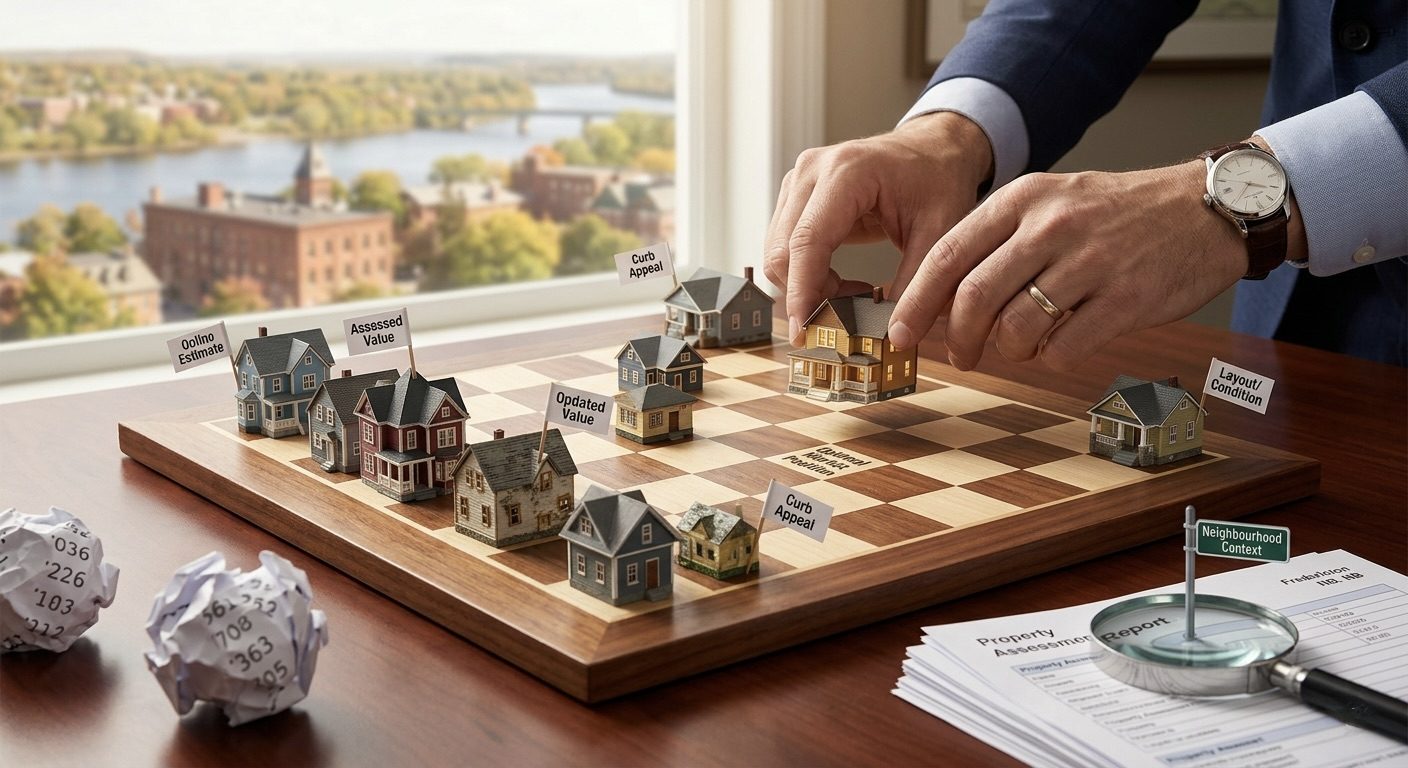
What your home is worth in Fredericton is not just about square footage or an online estimate. It depends on how your property compares to the competition buyers are seeing right now.
In Fredericton, your home’s value depends on the property itself, the neighbourhood, current buyer demand, recent comparable sales, and how your home stacks up against the competition buyers are looking at right now.
The issue is not that homeowners ask the wrong question. It is that they often stop too soon.
A better question is this.
What assumptions am I making about my home’s value that could hurt me when it is time to sell?
That is where the real conversation usually starts.
Most pricing mistakes do not happen when someone chooses a list price. They happen earlier, when a homeowner starts building expectations around the wrong number, the wrong comparable sale, or the wrong idea of how buyers will see the property.
That is why I tell homeowners the same thing every time.
I need to see the home.
Not because I am avoiding the question. Because I want to answer it properly.
A home’s value does not come neatly off a screen. It is shaped by the property, the neighbourhood, the condition, the layout, the competition, and the type of buyer the home is likely to attract. Get that wrong at the start and it can affect everything that follows, from pricing to preparation to timing.
If you are thinking about selling in Fredericton, here is what I think more homeowners need to understand before they put too much trust in an online estimate, an assessed value, or even their own instincts.
The First Mistake Is Treating Value Like One Fixed Number
This is where a lot of people drift off course.
They assume their home has one exact value sitting out there somewhere, waiting to be uncovered. As if the answer exists in a report, a calculator, or a website, and once you find it, the problem is solved.
That is not how the market works.
Market value is not one fixed number. It is more like a likely range based on what buyers are seeing, what else is available, and what they are willing to pay right now.
That distinction matters.
Once someone gets attached to one number too early, it becomes much harder to stay objective when the market starts sending back different signals.
The Second Mistake Is Anchoring to the Wrong Number
This is one of the biggest problems I see.
Sellers usually anchor to one of three things:
Their Assessed Value
An Online Estimate
The Highest Sale They Have Seen Nearby
Any one of those can be useful as a reference point. None of them should be treated as the answer.
Your assessed value is not the same as current market value. It is created for property assessment purposes, not to build a selling strategy. An online estimate may give you a rough ballpark, but it cannot walk through the home, feel the lot, see the condition, or understand how your property compares to what buyers are looking at right now. And the highest sale nearby only matters if it truly compares well to your home, which is often where things start to slip.
These numbers are not the problem by themselves.
The problem starts when a seller builds expectations around them.
That is usually where disappointment, overpricing, and poor decisions begin.
The Third Mistake Is Choosing the Wrong Comparable
This one is incredibly common, and honestly, very human.
Most sellers have a blind spot when they choose what homes compare to theirs.
That does not mean they are being unreasonable. It usually means they know their home too well. They know what they have spent. They know what they have improved. They know what makes it special to them.
Buyers do not compare homes emotionally. They compare them competitively.
A seller may be looking at the home they hope matches theirs, while a buyer may be comparing it to a different property with a better layout, a stronger lot, a more updated kitchen, or a quieter street.
That gap matters more than most people realize.
A home does not compete against the version of itself the seller has in mind. It competes against the other homes buyers are seriously weighing.
That is why choosing the right comparable sales is not just about matching square footage or staying in the same general area. It is about understanding what buyers are actually putting side by side.
The Fourth Mistake Is Underestimating How Much Buyer Type Affects Value
This is where local perspective really matters.
In Fredericton, different buyers care about different things. A young family may focus on schools, yard space, bedroom count, and how the home works day to day. A retiree may care more about one level living, lower maintenance, and a simpler lifestyle. A professional couple may be drawn to updates, style, convenience, and commute.
So when someone asks what their home is worth, part of the answer is always this.
Who is the likely buyer?
The value of a feature depends a lot on who is looking at it.
A home may feel ideal to one buyer group and just average to another. That can affect not only what buyers are willing to pay, but also how quickly the home attracts strong interest in the first place.
This is one reason online estimates often miss the mark. They do not think in terms of buyer fit. They just process data.
The market is more personal than that.
The Fifth Mistake Is Confusing Valuation with Positioning
This is the part many sellers overlook.
Pricing is not just about figuring out what the home is worth. It is also about deciding how the home will be positioned against the competition.
That is a different way to look at it.
A home may fall into a reasonable value range, but if it comes to market at the wrong number, it can lose momentum quickly. Price it too high and buyers may dismiss it or judge it more harshly against other options. Position it properly and it can generate stronger interest, better competition, and a better result.
That is why pricing is not just math.
It is strategy.
The real question is not only, what is my home worth?
It is also, how will buyers judge my home against the other homes they can buy right now?
That is a much more useful question, and it usually leads to better decisions.
Why Online Estimates and Assessments Can Create False Confidence
I am not against online estimates. They can be useful as a starting point.
But they are often given more weight than they deserve.
The issue is not that they are always wrong. The issue is that they are often incomplete in the exact places where money is won or lost.
They do not fully account for how a street feels. They do not always understand the difference between average condition and strong presentation. They do not know whether your lot feels private or exposed. They do not know how buyers are reacting to competing homes this week. They do not understand the difference between a home that looks fine on paper and one that creates stronger pull in person.
That is why I have seen the market pay far more, or far less, than the estimate suggested.
The estimate was not useless. It just was not enough.
That is the real problem. A rough estimate is fine. Building a selling plan around one is where trouble starts.
Why Home Value in Fredericton Is More Complex Than It Looks
Fredericton is not one simple, uniform market.
Different neighbourhoods behave differently. Different streets within those neighbourhoods can behave differently. Different buyer groups respond to different features. Even in the same price range, one home can attract more attention than another based on layout, condition, lot, or location.
That is why local context matters so much.
I am in homes every week. I see what buyers respond to. I see where sellers overestimate. I see where they underestimate. I see what happens when a home is positioned well, and what happens when expectations are built around the wrong number from the start.
That kind of perspective is hard to replace with a formula.
So What Should a Homeowner Do Instead?
Start with the right mindset.
Do not go looking for one magic number and assume that solves the problem.
Ask better questions instead.
What are buyers likely to compare my home to right now?
Which features will matter most to the most likely buyer?
Where could I be overestimating value?
Where might I be underselling strengths that buyers would pay more for?
How should this home be positioned in the current market?
Those questions lead to better decisions.
They also give you a stronger foundation for pricing, preparation, and timing.
How to Get a More Accurate Home Value in Fredericton
This brings me back to where I started.
I need to see the home.
That is not a script. It is the only way to understand where the property is likely to fit in the real market, not just on paper.
Two homes can look similar in a data set and perform very differently once buyers start walking through them. One may feel brighter, more functional, more private, more updated, or simply more appealing. Those differences matter.
A proper evaluation is not about chasing the highest number.
It is about getting closer to the right range, understanding how buyers are likely to judge the home, and making better decisions before the property ever goes live.
That is where value becomes strategy.
Frequently Asked Questions
Is assessed value the same as market value in New Brunswick?
No. Assessed value is created through the province’s assessment process for taxing, while market value reflects what a buyer may be willing to pay in the current market. Those two numbers can be quite different.
How can I find out what my home is worth in Fredericton?
If you are asking what is my home worth in Fredericton, the best step is to have a local REALTOR® see the home in person and evaluate it in the context of the current market.
Are online home value estimators accurate?
They can give you a rough estimate, but they often miss details that matter, including neighbourhood context, condition, updates, layout, and buyer appeal.
What affects my home’s value the most?
Some of the biggest factors are neighbourhood, micro location, property type, layout, condition, renovations, lot features, recent comparable sales, and current buyer demand.
Should I get a home evaluation before selling?
Yes. A proper evaluation gives you a more realistic sense of value, helps you understand how buyers are likely to see the home, and gives you a better basis for pricing and planning.
Final Thought
If you are asking what your home is worth in Fredericton, that is a fair question.
But it is only the beginning.
The more important question is whether you are building your expectations around the right assumptions.
Because the wrong number at the start can lead to the wrong pricing, the wrong preparation, and the wrong outcome.
If you want a clearer picture of where your home fits in today’s market, the next step is simple.
That is how you move from guesswork to judgment. That is how you get a more realistic understanding of value. And that is how you make smarter decisions before you list.
